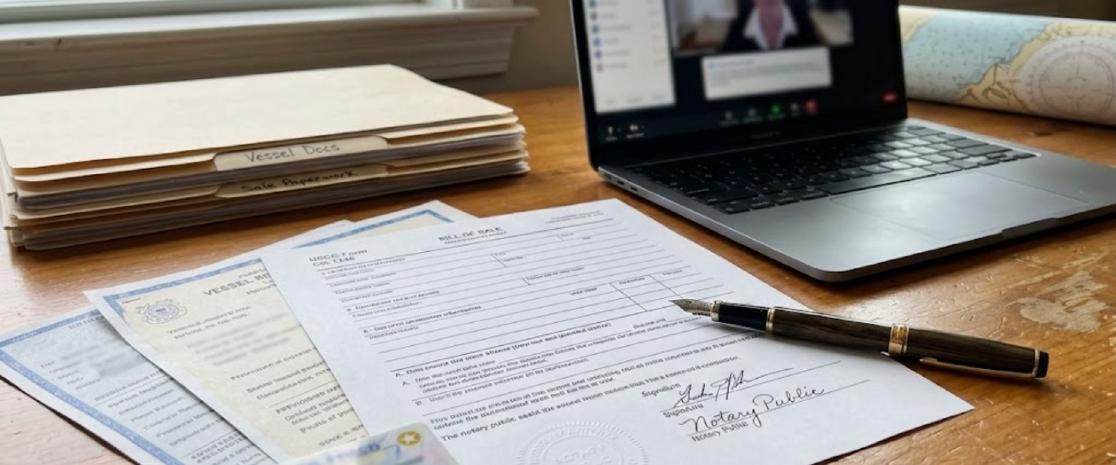
Notarizing a USCG Bill of Sale online requires a handful of specific documents to keep the transfer legal and smooth. This guide walks you through the items you’ll need for notarization, the forms required to transfer vessel ownership, and which ID documents are accepted for the CG-1340. If this is your first time, following these steps will help you avoid common delays. Use this checklist to prepare for your remote notarization and stay compliant with USCG rules.
Which Documents Are Required for a USCG Vessel Bill of Sale Notarization?
To complete a USCG Bill of Sale notarization successfully, you’ll need a small set of core documents. These verify identity, prove ownership, and allow the notary to complete the transaction. The essentials are:
- Identification: A valid government-issued photo ID (for example, a driver’s license or passport) to confirm the signer’s identity.
- Proof of Ownership: The vessel title or a previous bill of sale that shows legal ownership.
- Signature: A clear digital scan or image of your signature for upload when required.
- Document for Notarization: The completed Bill of Sale that needs the notary’s signature and seal.
| Document Type | Requirement | Description |
|---|---|---|
| Identification | Valid ID | Government-issued photo ID used to verify the signer’s identity. |
| Proof of Ownership | Title or Bill of Sale | Official paperwork that establishes who legally owns the vessel. |
| Signature | Digital Copy | A clear electronic image or scan of the signer’s signature for submission. |
| Notarization Document | Bill of Sale | The signed, ready-to-notarize Bill of Sale form. |
The table above summarizes the key documents to gather before your online notarization to help the process move quickly and without surprises.
What Forms Must Be Submitted to Transfer USCG Vessel Ownership?
When you transfer vessel ownership, certain forms are required so the USCG recognizes the change. The main items typically include:
- USCG Bill of Sale: The primary document that records the sale and transfer of ownership.
- Identification: A valid government-issued photo ID to confirm the seller’s identity.
- Additional Documentation: Depending on state or local rules, you may need transfer records, affidavits, or other supporting paperwork.
Which Identity Documents Are Accepted for the CG-1340 Form?
The CG-1340 requires a reliable ID to confirm the signer’s identity. Commonly accepted documents include:
- Valid Government-Issued Photo ID: Examples are a state driver’s license, U.S. military ID, U.S. passport, or a foreign passport when accepted.
- Verification Process: These IDs are used during the online identity check to validate the signer before notarization.
How Do You Complete and Verify the CG-1340 Form for Online Notarization?
Complete the CG-1340 carefully and follow these verification steps to ensure it’s accepted for online notarization:
- Prepare Required Documents: Fill out the CG-1340 but don’t sign it yet. Gather all supporting documents you’ll need to upload.
- Request Online Notarization: Submit a notarization request through your chosen online notary platform and attach the CG-1340 and supporting files.
- Identity Verification: Follow the link or instructions from the notary to complete the identity check using your accepted ID documents.
How Do You Fill Out the USCG Bill of Sale Form, Step by Step?
Accurate completion of the Bill of Sale is crucial. Follow these steps:
- Provide Vessel Information: Enter the vessel’s name, hull identification number (HIN), year built, and other identifying details.
- Seller and Buyer Information: Include full names and addresses for both parties exactly as they appear on IDs and titles.
- Signatures: Both buyer and seller must sign in the designated areas — leave the notary block for the notary to complete.
How Is Identity Verified Remotely for the CG-1340?
Remote identity verification uses secure methods to confirm the signer’s identity. Typical steps include:
- Document Submission: The signer uploads scans or photos of their ID for review.
- Session Recording: The notarization session is recorded to create a secure audit trail.
- Verification Confirmation: The notary confirms identity by matching the ID to the signer and the session recording.
What Is the Process for Scheduling and Paying for Remote USCG Bill of Sale Notarization?
Scheduling and payment are straightforward with most online notary services:
- Choose a Notary Service: Pick a reputable provider that supports USCG Bill of Sale notarizations.
- Schedule an Appointment: Book a convenient date and time through the provider’s online calendar.
- Payment: Complete payment according to the platform’s options — fees and methods vary by provider.
How Do You Schedule an Online Notarization Appointment for Vessel Documents?
To schedule your appointment, follow these simple steps:
- Create an Account: Sign up on the notary service’s website.
- Upload Documents: Add the Bill of Sale, CG-1340, and any supporting files.
- Select Appointment Time: Pick a time that works for you and join the confirmed session for your online notarization.
What Are Typical Pricing Options for Remote USCG Notary Services?
Fees vary by provider and complexity. Common pricing examples include:
- Basic Notarization: Often around $25 per notarial act for standard documents.
- Real Estate or Multi-Document Package: Packages that cover several documents may run about $75.
- Expedited or Emergency Service: Rush appointments can cost around $100 or more depending on availability.
Common Questions About USCG Vessel Ownership Transfer Documents
People frequently ask about the notarization and transfer process. Typical questions include:
- What documents are required for notarization?
- How long does the notarization process take?
- Can I notarize a USCG Bill of Sale online?
Which Documents Prove Vessel Ownership During Notarization?
To prove ownership, you’ll usually need one or more of the following:
- Vessel Title: The official title showing legal ownership.
- Previous Bill of Sale: Records of the last ownership transfer.
- Identification: A current government-issued photo ID to confirm the owner’s identity.
Can You Notarize a USCG Bill of Sale Online?
Yes — you can notarize a USCG Bill of Sale online if you meet the platform’s document and identity verification requirements. Submit the necessary paperwork electronically and complete the verifier’s identity checks to proceed.
How Do Recent Regulatory Updates Affect Online USCG Bill of Sale Notarization?
Recent updates aim to make online notarization more secure and accessible. Changes to watch for include:
- Expanded Acceptable Documents: Some jurisdictions now accept a wider range of identification documents for remote notarizations.
- Enhanced Security Measures: There’s increasing emphasis on secure session recording and stronger identity verification to reduce fraud.
What New Identity Verification Methods Are Accepted for Remote Notarization?
New verification methods are improving security and convenience for remote notarization:
- Multi-step Verification: Combining document checks with biometric or behavioral checks for stronger identity proof.
- Session Recording: Keeping a recorded session for compliance and audit purposes.
Research increasingly points to behavioral biometrics — such as typing patterns and mouse movements — as effective, unobtrusive tools to continuously verify a user’s identity during remote processes.
Secure Remote Identity Verification with Biometrics
As remote work and online services expand, identity verification must evolve to stay effective. Traditional single-factor methods (like passwords) don’t provide continuous assurance and can be vulnerable to attacks. Behavioral biometrics — including keystroke dynamics and mouse movement patterns — offer a less intrusive, continuous way to authenticate users based on their unique behavior.
AI-Based Identity Verification Through Behavioral Biometrics: Enhancing Remote Work Security, M Awawdeh, 2024
How Will USCG Guidelines Affect Document Requirements Going Forward?
USCG guidance continues to evolve, which can change what documentation and verification methods are required. Keep these points in mind:
- Updated Documentation Standards: New guidance may tighten requirements for ownership proof and identity verification.
- Future Compliance: Stay informed about regulatory updates to ensure your transactions remain compliant.
Frequently Asked Questions
What should I do if I don’t have a government-issued photo ID for notarization?
If you don’t have a government-issued photo ID, check with your chosen notary service about accepted alternatives. Some providers allow secondary documents (like a recent utility bill or bank statement) plus a witness, but rules vary by state and platform. Always confirm requirements with the notary beforehand and make sure any alternative documents clearly show your name and current address.
How can I ensure my online notarization session is secure?
Pick a trusted notary service that uses encryption, records sessions, and requires strong identity verification. Confirm the notary is licensed and follows state rules, avoid sharing sensitive information over unsecured networks, and conduct the session from a private location to keep your data safe.
What happens if I make a mistake on the USCG Bill of Sale form?
If you find an error, correct it before notarization. Minor mistakes may be crossed out and initialed, but significant errors usually require starting a new form. Notaries typically won’t notarize documents with unresolved mistakes, so double-check names, dates, and vessel details first.
Can I use a digital signature for the USCG Bill of Sale?
Many online notary platforms accept digital signatures, but acceptance depends on the notary service and jurisdiction. Confirm that your chosen platform supports digital signatures and that the signature meets USCG and notary requirements before your session.
What should I do if my vessel is registered in a different state?
Even if your vessel is registered elsewhere, you must follow USCG guidance for ownership transfer and notarization. Have the original title and previous bills of sale ready, and check whether your home state has additional notarization rules. Consulting a local notary or legal advisor familiar with interstate vessel transfers can help avoid issues.
How can I track the status of my notarization request?
Most online notary services provide tracking via their website or app and will send email updates as your request progresses. If you don’t see updates, contact the provider directly for a status check and any needed clarification.
Conclusion
Gathering the right ID, proof of ownership, and completed forms makes online USCG Bill of Sale notarization much smoother. Follow the steps outlined here, confirm requirements with your notary, and use a reputable remote service to complete the transfer securely. When you’re ready, schedule an appointment with Remote NotarEZ to explore our online notary services to get started with your vessel ownership transfer.