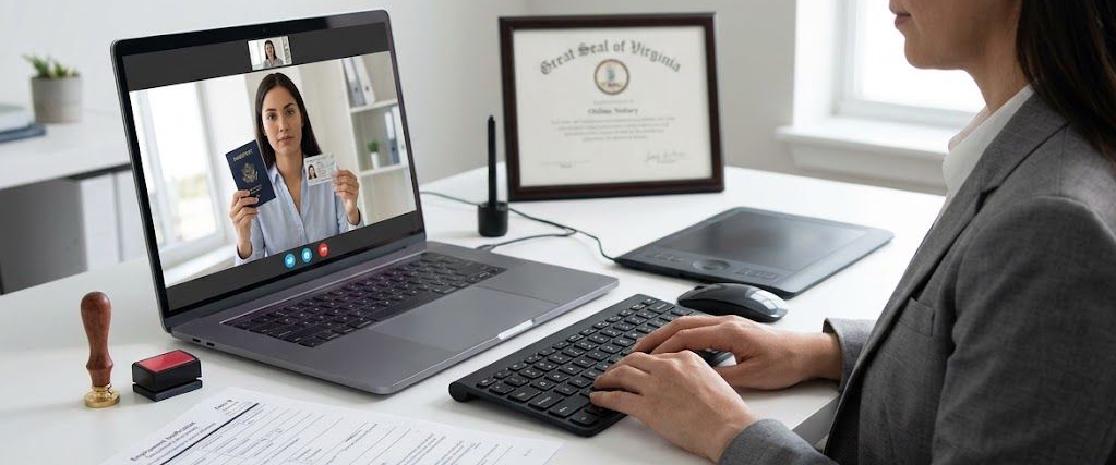
Form I-9 verification requires physical, in-person document examination under federal rules, not notarization. Remote NotarEZ’s Virginia-commissioned notaries handle remote online notarization for documents like DS-3053. Standard Form I-9 completion falls outside RON scope. Employers should designate an authorized representative to review documents in person for compliant, timely verification.
Can a Virginia Online Notary Complete Form I-9?
Federal rules permit employers to designate an authorized representative to complete Form I-9 on the company’s behalf. A notary public qualifies for this role. Remote NotarEZ serves as that USCIS remote authorized representative for Virginia employers who cannot bring new hires into an office. Our online notary service Virginia connects HR teams. Remote employees through a secure video session, letting a commissioned notary examine identity documents without an in-person meeting.
Federal regulation still requires physical document examination while the employee is physically present, even in a remote setting. Our video sessions replicate that in-person review through live document verification, satisfying the same standard the law demands. Employers cannot skip this step just because the hire works from home.
Who is legally responsible for I-9 accuracy?
Liability stays with the employer, not the notary completing the form. Designating an authorized representative does not transfer legal accountability for errors or verification failures. We handle the mechanics of remote document review carefully. Employers must still confirm their internal I-9 process meets compliance standards.
Is remote I-9 notarization allowed for Virginia hires?
Yes. Regulatory changes now permanently authorize online I-9 notarization for remote workers, making remote I-9 verification Virginia employers rely on a standard practice rather than a temporary workaround. This shift benefits several groups:
- HR departments onboarding distributed teams across Virginia
- Hiring managers who need same-day verification turnaround
- Remote employees who live far from a corporate office
- Businesses standardizing compliant onboarding workflows statewide
Remote NotarEZ built its platform around this authorization, pairing Virginia-commissioned notaries with guided identity verification. Employers get a documented, audio-video record of each session, supporting the compliance trail regulators expect.
Why Does Remote I-9 Verification Matter for Virginia Employers?
Virginia employers carry a federal mandate to complete Form I-9 for every new hire. Remote work has made that mandate harder to satisfy in person. Congress created the requirement through the Immigration Reform. Control Act of 1986, establishing Form I-9 as the standard document for verifying work authorization. That law hasn’t changed, but the modern workforce has. Employers across Virginia now hire remote staff scattered across counties and, often, other states entirely.
Skipping or delaying proper verification carries real risk. Noncompliance with Form I-9 rules exposes an employer to fines and legal complications, regardless of company size or industry. Our online notary service Virginia platform helps HR teams close that gap by bringing certified identity verification directly to the remote hire, wherever they’re working from.
What deadline applies to remote hires completing Form I-9?
Remote employees must complete remote I-9 verification Virginia requirements within three business days of their start date. That window is tight, especially when a new hire lives far from company offices or lacks easy access to an in-person notary. Missing the deadline creates unnecessary exposure for the employer, not the employee.
We built our platform to meet that deadline without friction. Our process includes:
- Secure document upload before the scheduled session
- Identity verification through credential analysis
- A live audio-video session with a Virginia-commissioned notary
- Prompt, secure delivery of completed documents
Employers must ensure compliance with federal requirements while designating a USCIS remote authorized representative, keeping verification fast, documented, and defensible.
How Does Remote NotarEZ Handle I-9 Notarization?
Virginia-commissioned notaries staff every remote I-9 session we conduct. Employers across Virginia rely on our platform for online notary service Virginia transactions because our notaries hold state commissions before they ever touch electronic notarization work. We contract with Virginia Electronic Notaries, meaning each professional first earns a traditional Virginia notary commission, then applies separately to the Commonwealth for electronic notary authorization.
That second application involves real vetting, not a rubber stamp. Notaries submit proof of their electronic seal, backed by a digital certificate, to the Secretary of the Commonwealth. Several steps follow before approval clears. This layered process gives Virginia employers a documented chain of authority behind every completed form.
What does a remote notarization session actually look like?
Our notaries meet signers through live audio-video conferencing rather than a static upload form. The process mirrors an in-person notarization, just conducted over secure video technology instead of across a desk. Employees anywhere in Virginia, or outside the state entirely, connect with a commissioned notary in real time.
Are Remote NotarEZ notaries trained specifically for I-9 documentation?
Our Virginia notaries carry the knowledge. Tools needed to walk signers through the electronic notarization process comfortably, including remote I-9 verification Virginia employers require for new hires. HR teams gain a consistent, guided experience rather than a confusing self-service portal.
We built our platform around this structure for good reason:
- Commissioned Virginia notaries handle every session personally
- Electronic notary status comes only after separate state approval
- Audio-video meetings replicate the rigor of in-person signing
- Guided support reduces errors during document completion
Employers managing a USCIS remote authorized representative arrangement gain a compliant, well-documented notarization partner through this framework.
What Makes Remote NotarEZ a Trusted Authorized Representative?
Three independent credentials separate Remote NotarEZ from ordinary online notarization tools: MISMO certification, an A+ BBB accreditation, and vetting by Secure Insight. Employers verifying I-9 compliance for Virginia hires need a partner whose standards hold up to audit, not just a website that promises convenience. We built our platform around that expectation.
Our online notary service Virginia employers rely on carries MISMO certification, a mark that confirms adherence to established industry standards and documented best practices in electronic notarization. HR teams handling multi-state hiring often ask how to distinguish a compliant e-notary from one cutting corners. Certification status is a fast, reliable signal.
Accreditation matters just as much as certification. Holding an A+ rating from the Better Business Bureau reflects our ongoing commitment to transparency, dependable service, and customer satisfaction. Three qualities hiring managers weigh heavily when selecting a vendor for sensitive employment documentation.
Is Remote NotarEZ vetted for security and confidentiality?
Yes. We serve as a trusted vendor for The Fund and have been vetted. Verified by Secure Insight, an outside review that underscores our confidentiality practices and security posture. Remote employees submitting identity documents deserve that added layer of scrutiny.
Can Remote NotarEZ act as a USCIS authorized representative for I-9 verification?
Federal guidance does not require an authorized representative to hold specific agreements or additional paperwork to complete Form I-9 duties. This makes our remote I-9 verification Virginia offering a natural fit: our commissioned notaries function as a USCIS remote authorized representative, examining documents, confirming identity, and completing the employer’s verification steps without added contractual barriers slowing the hiring process.
How Do You Get Started With Remote I-9 Verification?
Getting started requires three steps: uploading employment documents, completing identity verification, and joining a live video session with a Virginia-commissioned notary. Remote NotarEZ built the online notary service Virginia employers trust around this straightforward sequence, cutting weeks of paperwork delays down to one scheduled appointment.
Employers managing remote hires face a tight federal deadline for completing Form I-9. Our notaries have handled document verification for years, giving our team extensive practice guiding signers through identity checks quickly and accurately. Appointments typically wrap up in about 15 minutes. New hires aren’t left waiting between an offer letter and their first paycheck.
Can international employees complete Form I-9 remotely?
Yes. Signers located outside the United States still connect with our Virginia Electronic Commissioned Notaries through the same online platform. This matters for companies onboarding overseas talent, or for U.S. citizens working abroad who can’t reach a local notary office before their deadline.
Is remote I-9 verification available in Virginia and beyond?
Remote I-9 verification Virginia employers rely on fits into a broader national shift toward permanent remote-hire authorization, with availability now reported across a While Form I-9 verification presents distinct challenges within Virginia’s notarization framework, remote online notarization remains a valuable tool for many other critical documents requiring authentication. Organizations and individuals seeking compliant, efficient notary services benefit from understanding these regulatory boundaries and exploring solutions tailored to their specific documentation needs. Remote NotarEZ stands ready to support your legitimate notarization requirements with professional, secure service.
Conclusion
Form I-9 verification for Virginia hires calls for in-person document examination rather than notarization, which is why Remote Notarez Hampton Roads Notary Public LLC positions its Virginia-commissioned notaries as authorized representatives, not notarial officers, for this task. Liability for I-9 accuracy stays with the employer, while the notary’s role is limited to examining identity documents through a live audio-video session that meets the same physical-presence standard federal rules require. Remote NotarEZ’s MISMO certification, A+ BBB accreditation, and Secure Insight vetting back that role with a documented, secure verification process available to remote and international hires within the three-business-day deadline. If your organization needs a compliant way to designate an authorized representative for remote Form I-9 verification in Virginia, reach out to Remote NotarEZ for a guided video session that keeps your onboarding on schedule.